
THE URGENCY OF ART
By Nick Cheney
The purpose of art has always been slippery. Most might think the most obvious role for art would be decorative, a pretty thing that does what it’s told. Others recognize it as a political tool, a mirror, and a provocation, especially in moments of turmoil. It is during the political crisis that the slipperiness starts to feel like a problem. Examining contemporary works of art, especially through a historical lens, can help clarify art’s purpose and remind us of its power.
A most relevant example is Signs of Dissent, shown at Blackfish Gallery in Portland, Oregon (February 2 – 28, 2026). A group show of twenty artists, the exhibition made no bones about art’s purpose. For this group, art is an explicit reaction to our political moment. But, more importantly, the work in the exhibition showcased how we can look to works of art to better divine their goals and functions; as well as highlight the urgency of art, both for its own sake, and for society at large.
Of the exhibition’s pieces, Paula Bullwinkel’s Ava, Abiona, Wendy, Beatrice, Carol, Jess, and Unknown (2025), most immediately carries visual traces of our current political moment. The colors and textures, the warped physical space, and the fear conveyed on the faces of many figures, with no immediately perceptible cause, are all stylistic elements, vehicles of emotional content that speak directly to our shared reaction to this political moment.
The content draws from sources we’d recognize as political. You’ve seen the faces in Ava, Abiona, Wendy, Beatrice – a woman wearing a headscarf, seemingly fleeing, with her hands up is an archetype that will be resonant to anybody who saw images coming from the Israeli genocide in Gaza or the ICE actions persecuting Americans in Minneapolis. But the stylistic and aesthetic elements can be interpreted in the same way as the painting’s content. The strange lack of cohesion between the figures and the wild patterning of their clothing and environment evoke the patchwork nature of how we receive information now.
These stylistic elements echo a visual language developed over a century ago by artists grappling with eerily familiar pressures. Consider Ludwig Kirchner’s Nollendorfplatz (1912) and his emphasis on the artificial nature of urban life with an unnatural and sickly color palette. Kirchner also highlighted the mental aberration that accompanies an urban lifestyle with patchy, blunt and gestural brushwork and an almost fisheye perspective of the cityscape. Bullwinkel’s painting calls upon Kirchner’s visual language by warping the cityscape and relying on unreal colors and an altered patterning of the environment.
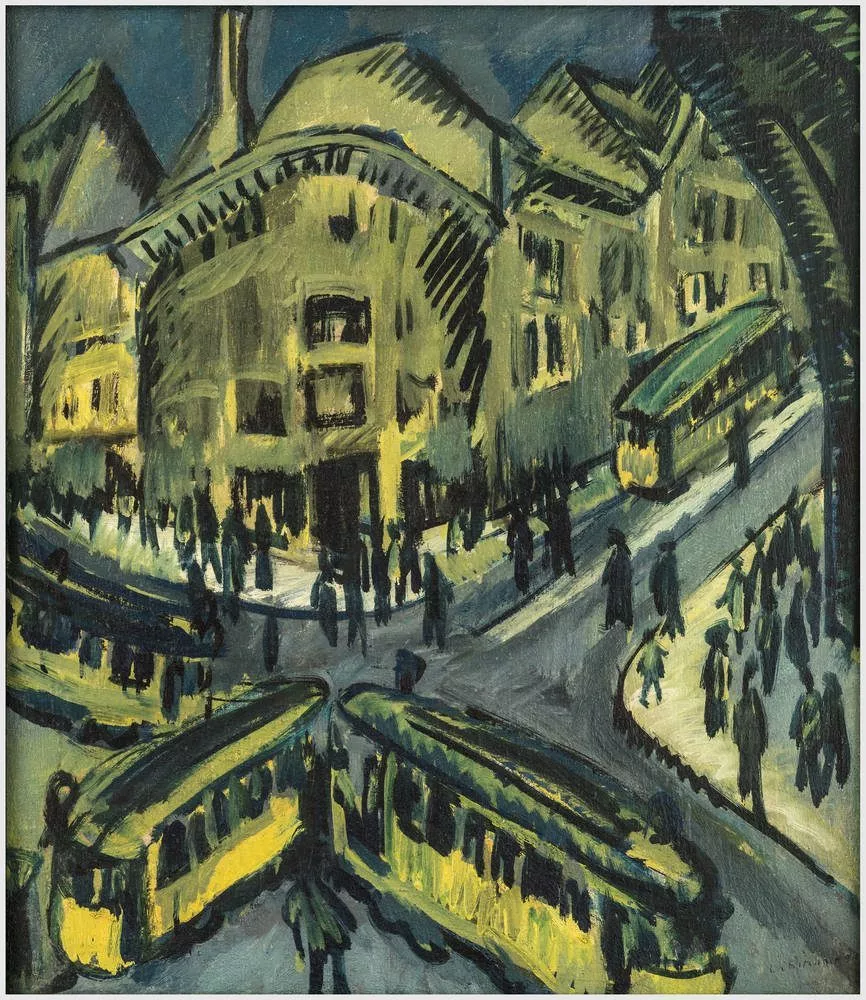
Kirchner was a German Expressionist and for our purposes we will focus on the context in which art of that movement was made. Germany in 1912 was a rapidly militarizing and modernizing state about to be plunged into the technologically enabled catastrophe that was World War I, which would be followed by the rise of the Nazi party and World War II. Bullwinkel’s style is not the same as Kirchner’s, but it rhymes with it. These stylistic touches have become relevant again because the pressures that produced them have too; our moment looks like theirs.
Many other pieces from Signs of Dissent contain modernized allusions to Expressionism. Take Mae Al-Jiboori’s The Normalization of Force (2025). It exudes a feeling of terror, movement, power, and speed stemming from a quasi-abstraction.
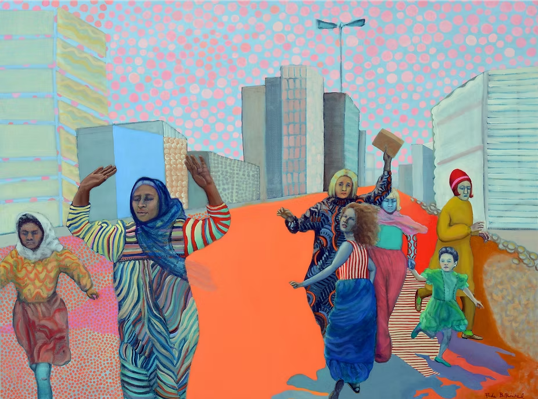
Paula Bullwinkel’s piece Ava, Abiona, Wendy, Beatrice, Carol, Jess, and Unknown (2025).
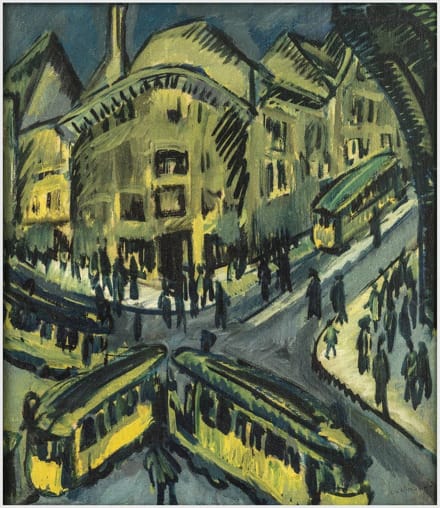
Ludwig Kirchner’s Nollendorfplatz (1912)
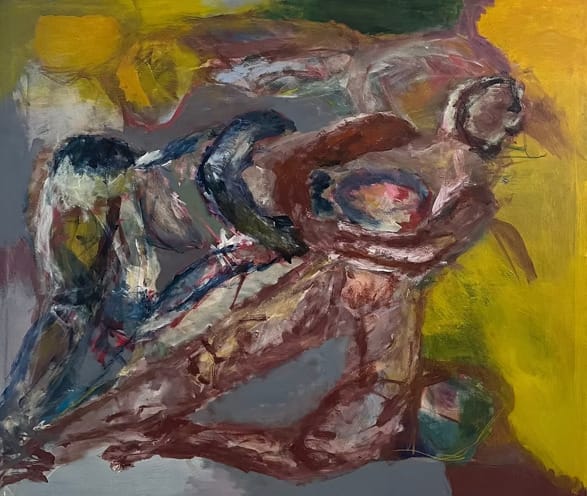
Mae Al-Jiboori’s The Normalization of Force (2025)
These, along with the broad smears of paint and gestural qualities of the figures, are all hallmarks of Expressionist painting, especially in the superheated political context of pre-World War I Europe. Where Al-Jiboori speaks to state brutality directly and does so unflinchingly, Kirchner relied on distorting urban life to show its psychological toll. Al-Jiboori’s piece is far more politically explicit than most German Expressionists, often oblique in its commentary on the conditions of modernity – urbanization, alienation, industrialization. Coupled with its title, the figures in Al-Jiboori’s work read as someone being brutalized by an agent of the state. The terror, power, and speed in the brushwork make the anti-authoritarian message impossible to ignore.
Other pieces from Signs of Dissent were even more overt. Carol Benson, Aaron Johanson, and Clint Brown all used Trump’s face at least once, in ways that echo both Expressionism and Dada – an art movement of the interwar period, categorically condemned by the Nazis. Clint Brown’s No Evil Triptych (2025) evokes Dada’s tools of vulgarity in the grotesque quality to Trump’s face and references to mass media. Carol Benson’s COVFEFE (2025) has more of the Ben Garrison cartoon about it, juxtaposing a quaint reference from America’s relatively tame recent political past in the title with another grotesque caricature of Trump’s face alongside printed words which spell out nearly every buzzword, fear, and notable movement relevant to the political moment in which it was created. These reflections and satires of mass media were a core part of both Dada and Signs of Dissent.
The comparison to Germany may be dramatic, but it is not unfounded in light of recent events. Signs of Dissent, like the German movements previously mentioned, grew out of its own tradition of resistance. The idea that history repeats itself and artists reuse techniques is not a coincidence; it’s the cyclical nature of resistance making itself known. When it comes to resistance, the function of art hasn’t changed much between then and now. Art is an act of resistance in and of itself. But more crucially, it performs resistance. It gives form, shape, and character to resistance. Look at what artists are reaching for instinctively – the distortion, the vulgarity, the satire – and ask yourself what that tells you about where we are. The artists aren’t instructing; they’re signaling. If art has always been the canary in the coal mine, then Signs of Dissent was it singing.
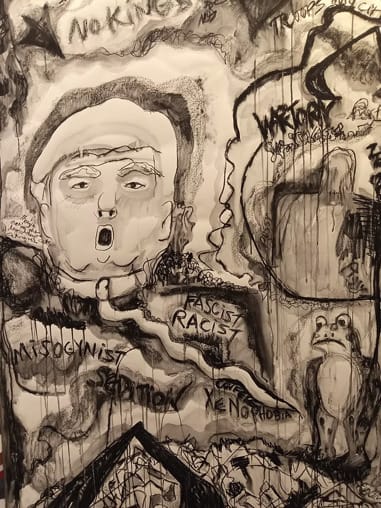
Carol Benson’s COVFEFE (2025)
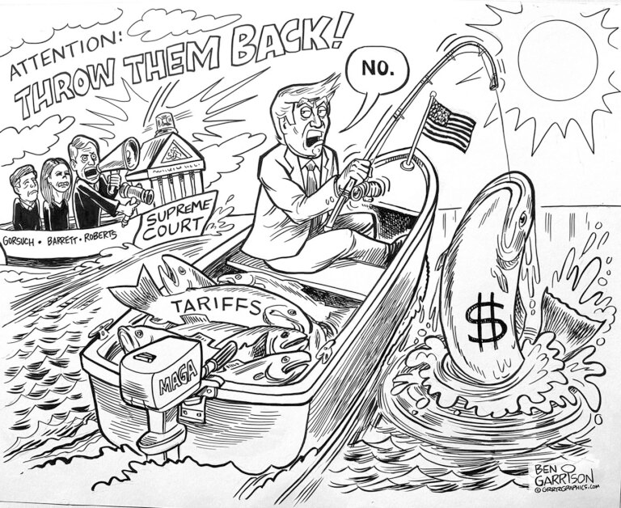
Ben Garrison’s Tariff Harder original art