Soft Power In A Digital Third Space
By Corrina Espinosa and Molly Valentine Dierks
As designers/artists, we were–alongside many of you–shaken to learn the Trump administration was in the process of destroying public monuments that celebrated inclusion and diversity. The administration’s erasure of inclusive public culture has continued, from federal monuments to museum programming to public art. In response, and in the spirit of creative defiance, in March of 2025, we began discussing how we could use design in virtual space to resurrect those same monuments.
The first of these was the BLACK LIVES MATTER PLAZA, a beautiful street mural with letters thirty- five feet high and two blocks long in the political heart of Washington, DC. In response to a movement to recognize the importance of Black lives and citizens, the installation was commissioned by Mayor Bowser to acknowledge “people who are craving to be heard and to be seen and to have their humanity recognized.” An act of unity, it was painted by seven artists, working with the DC Department of Public Works and the MuralDC Program, in 2020
Five years later, it was destroyed, not by direct federal order, but under threat of losing federal funding, demanded by Republican congressman Andrew Clyde as the price of DC’s compliance. The removal was part of a broader white nationalist agenda that includes the sanctioning of a violent ICE paramilitary, the censuring of diversity initiatives and narratives, and decreased access to and funding for essentials like education, health, and clean environments.
The scraped, vacant blacktop where the monument once was left us feeling disheartened, angry, and powerless, both as artists and US citizens. After discussion, we decided to take action, using our skills in digital media, and passion as designers and public artists. We created “Soft Power” to digitally revive, in altered form, two chosen monuments through augmented reality: the BLACK LIVES MATTER street mural in DC, and the Orlando, Florida rainbow crosswalk, created in memoriam to the forty-nine people killed at the LGBTQIA+ Pulse nightclub shooting in 2016.
Five years later, it was destroyed, not by direct federal order, but under threat of losing federal funding, demanded by Republican congressman Andrew Clyde as the price of DC’s compliance. The removal was part of a broader white nationalist agenda that includes the sanctioning of a violent ICE paramilitary, the censuring of diversity initiatives and narratives, and decreased access to and funding for essentials like education, health, and clean environments.
The scraped, vacant blacktop where the monument once was left us feeling disheartened, angry, and powerless, both as artists and US citizens. After discussion, we decided to take action, using our skills in digital media, and passion as designers and public artists.
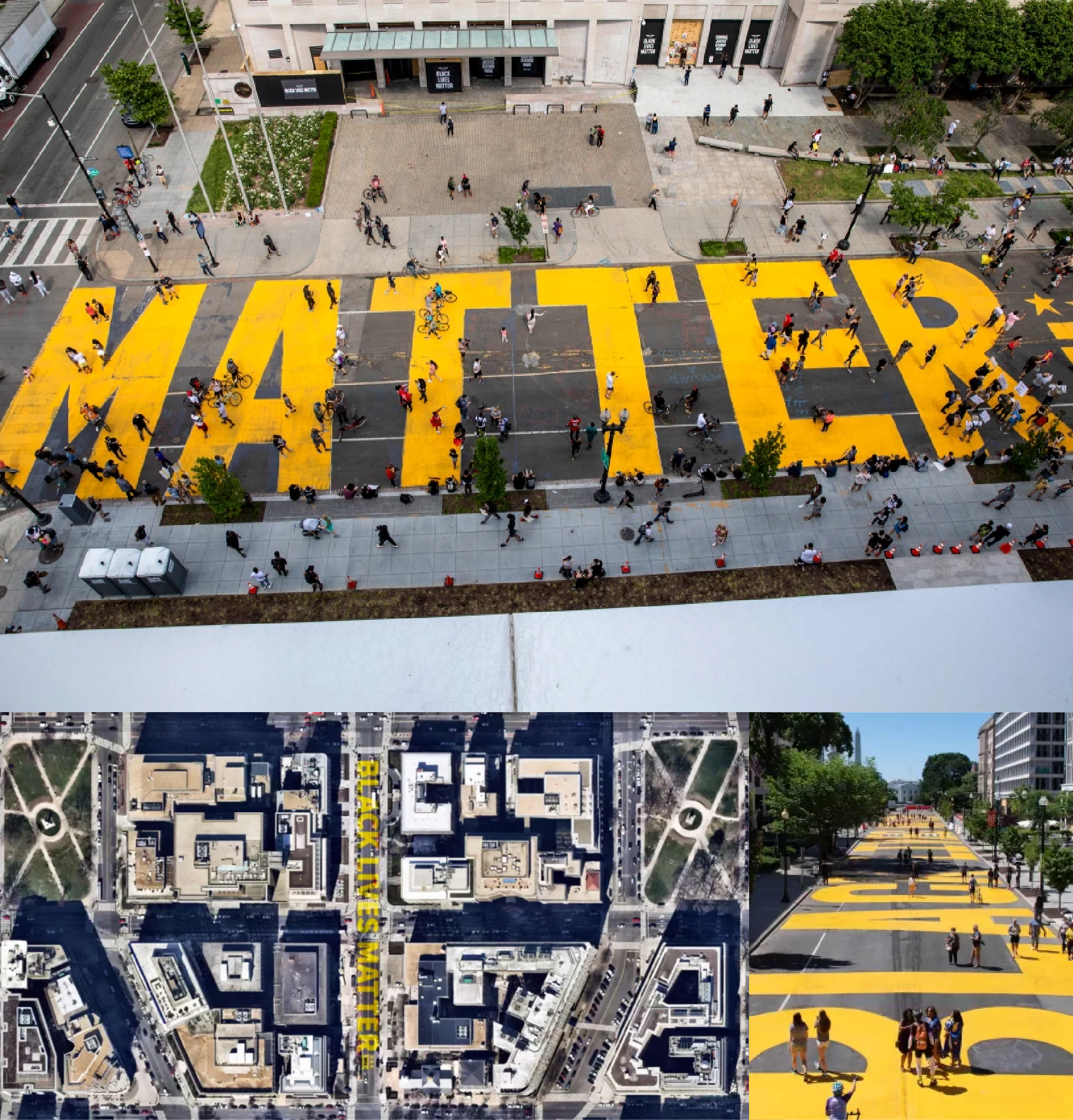
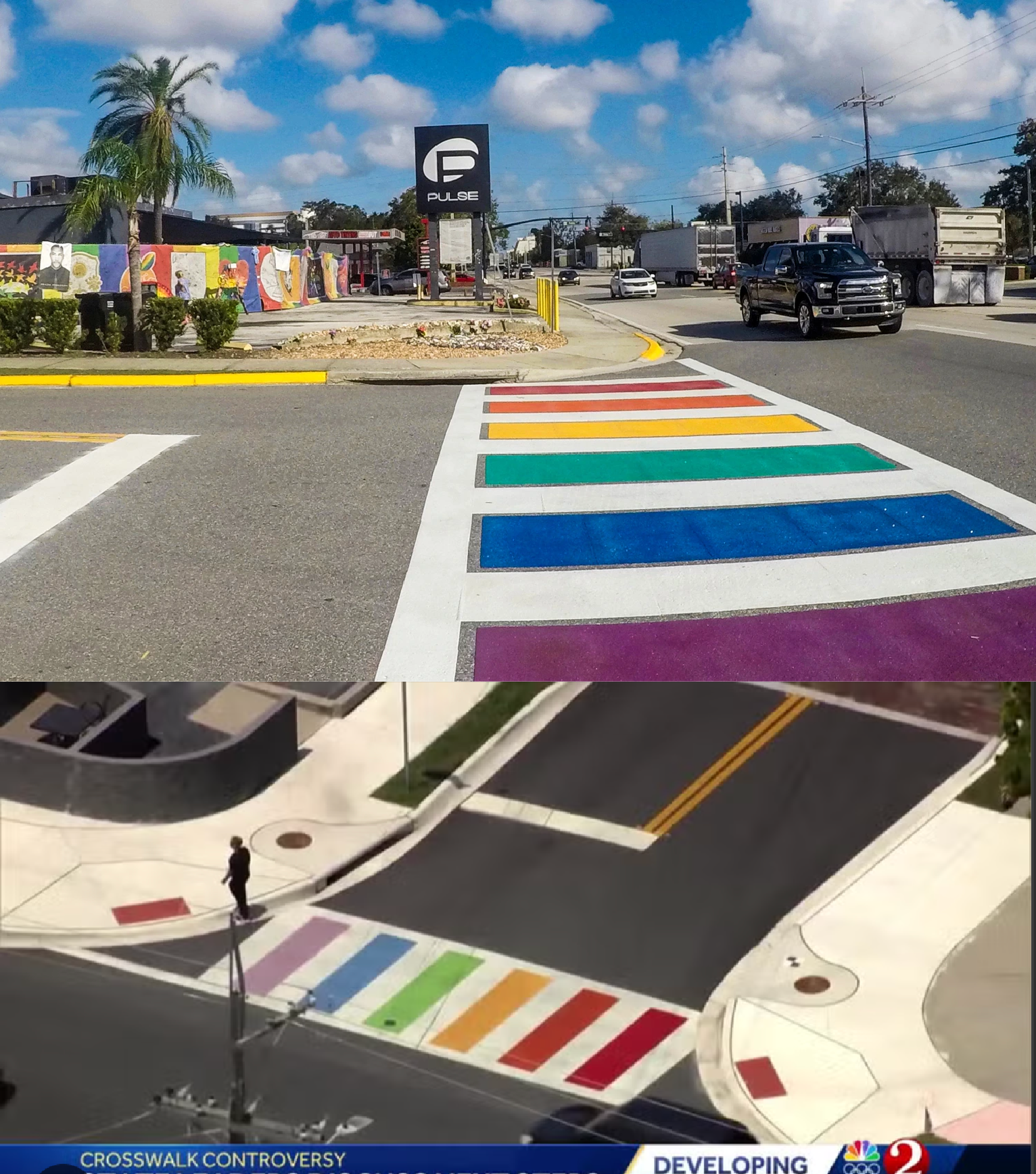
We created “Soft Power” to digitally revive, in altered form, two chosen monuments through augmented reality: the BLACK LIVES MATTER street mural in DC, and the Orlando, Florida rainbow crosswalk, created in memoriam to the forty-nine people killed at the LGBTQIA+ Pulse nightclub shooting in 2016.
“Soft Power” is hosted on a DIY digital platform called Denver Digital Land Grab, which Espinosa co-founded in 2022 specifically for artists to reclaim space, digitally, when physical space is gentrified, lost, stolen, or otherwise unavailable. The renegade spirit ingrained in the platform is made clear in its motto, “We are taking space, we are NOT asking permission.”
The power of Augmented Reality (AR) is its greatest strength. It exists in a realm somewhere between digital and analog worlds, making it virtually impossible to remove. There are no laws that govern virtual space, and the platform intentionally bypasses corporate entities: the app store cannot simply remove it, and Trump’s administration cannot pressure-wash it away.
This tech, however, does come with limitations. “Soft Power” is a site-specific virtual installation, which means viewers must be physically present at the Capitol, or the location of the (now closed) Pulse nightclub, to experience it. Not only do you need to be there, you also have to know it’s there. Unlike the original monuments, ours are invisible until activated through a mobile device, which means a large part of our project is a grassroots campaign to spread the word through a variety of methods, including social media, stickers, posters, and word of mouth.
“Soft Power” only addresses the erasure of certain monuments, those with social and political significance that champion inclusion, acceptance and diversity over exclusion, oppression, racism, or nationalism. Contrary to Confederate statues dismantled by citizens and governments over the past decade, the DC BLM Plaza and the Pulse rainbow crosswalk were rooted in inclusivity, rather than in the commemoration of people and regimes that upheld systems of slavery and oppression, that victimized and silenced entire populations.
The same narratives of domination that uphold confederate leaders as “heroes” are part of structures rooted in international powers, termed either “hard”—using military and economic force to dominate—or “sharp”: aggressive policies that disempower and manipulate, often by distorting, obfuscating, and controlling narratives and information. Contrary to “hard power” and “sharp power”—powers of exclusion and dominance—“Soft Power” is the power of inclusion, celebration, and true democracy. It is the power created by freedom of speech, and a rich landscape of cultural expression and celebrated histories; defined as the power of a nation to attract, versus suppress, coerce, or dominate.
In “Soft Power”, scanning a QR code doesn’t bring the monuments back. It reveals re-imagined versions of them. The rainbow crosswalk becomes joyful animated rainbow cubes and floating orbs, and the Black Lives Matter mural becomes large, upright block letters elevated in front of the nation’s Capitol, hovering before the plaza.
This is why we chose the title “Soft Power”. We do not aim to replace or rewrite these monuments, but to reference them: to cultivate similar feelings of hope, togetherness, and strength that engendered their creation.
With “Soft Power”, access to these digital monuments is an invitation, a choice. Having removed the public’s choice to engage in the BLM and Pulse monuments, the Trump administration seeks to whitewash history. ”Soft Power” replaces systematic exclusion with inclusive design, joining other acts of artistic and social solidarity to revive voice, choice, and the joyful, collective, creative occupation of public spaces.
“What erasure removes from public space, “Soft Power” returns, not as restoration, but as reimagination.”
References:
- WashingtonDC.org, “Guide to Black Lives Matter Plaza,” accessed March 11, 2026, https:// washington.org/visit-dc/black-lives-matter-plaza. Kyle Chayka, “The Mimetic Power of DC’s Black Lives Matter Mural,”
- The New Yorker, June 9, 2020, https://www.newyorker.com/culture/dept-of-design/the-mimetic-power-of-dcs-black-lives-matter-mural.
- Michael Ray, “Orlando Shooting of 2016,”Britannica, February 13, 2026, https://www.britannica.com/event/Orlando-shooting-of-2016.
- Wikipedia, “Hard Power,” last modified December 3, 2025, https://en.wikipedia.org/wiki/Hard_power; Wikipedia, “Sharp Power,” last modified April 5, 2025, https://en.wikipedia.org/wiki/Sharp_power.
- Rachel Owens, “How Can Democracies Defend Against the Sharp Power of Autocrats?” Stanford Freeman Spogli Institute for International Studies, April 29, 2024, https://fsi.stanford.edu/news/how-can-democracies-defend-against-sharp-power-autocrats.
- Council on Foreign Relations, “What is Soft Power?” accessed May 16, 2023, https://education.cfr.org/learn/reading/what-soft-power.org/Visit-DC]